Why You're Busy But Not Productive
Mar 17, 2026It's 5:15pm. You close your laptop and try to recall what you actually accomplished today.
You were busy. You know that. You responded to that email from your biggest customer within ten minutes. You hopped on a call with a teammate who needed your input on a proposal. You put out two fires before lunch that would have cost the business real money if you'd ignored them. You answered fourteen messages from people you care about and want to support.
You did rational things all day long. Every single "yes" made sense in the moment.
And yet, that strategic initiative you committed to last Monday? Untouched. The project plan your boss asked about on Friday? Hasn't moved. The thing that you KNOW will create the most value for your team, your company, your career? Still sitting exactly where it was yesterday. And the day before. And the day before that.
You're not lazy. You worked incredibly hard today.
So what happened?
We Say "Yes" to Avoid Pain For Us and Others
Here's what happens: we get interrupted. A lot. And most of the time, we say "yes" for two very important reasons:
- We're afraid that saying "no" will hurt us - We say "yes" to avoid missing an opportunity, to avoid conflict that might come back to bite us, or because we think we HAVE to in order to avoid pain.
- We're afraid that saying "no" will hurt others - We're tribal beings. We don't want to damage the relationships that matter to us, because damaged relationships come back around and hurt us anyway.
Both fears are really the same fear: we get hurt.
None of those individual "yes's" are wrong. That customer email? Important. That team member's need? Vital (at least to them). Those fires? Real.
The problem isn't any single "yes." The problem is that without a plan, "yes" is your default setting.
And when "yes" is your default setting, your priorities are going to lose every single time, and all the while you'll stay "busy".
You're Not Being Productive, You're Performing
When you allow endless "yes's", a funny thing happens: you stop being productive on your priorities, and you instead start performing.
- You perform for others - Responding quickly to messages, putting out fires, showing up as the reliable person everyone counts on. You may even get promoted for it.
- You perform for yourself - Every email answered, every fire extinguished gives you a little piece of evidence that your role is valuable and important.
You keep doing this because these performances avoid short term pain and feel like progress ("Look how much I'm getting done!"). Except you're crushing the urgent stuff, not the important stuff. YOUR stuff. The work that only you can move forward sits untouched.
This isn't an effort problem: you're working extremely hard.
This isn't a knowledge problem: you actually know what you SHOULD be working on.
It's a planning problem.
Without a plan, your brain will always perform reactive work, because it avoids short term pain and feels like progress.
You Need a Sober Moment to Decide How You Actually Create Value
Imagine you could only work one hour a week, and your entire job was to plan priorities for an employee who executes all week based on your direction.
In that sober moment, you'd choose items aligned to your highest priorities. Strategic goals. Leading indicators. The things you KNOW create value and are worthy of your employee's finite and valuable time. You map these priorities to your employee's calendar, and tell them to treat the calendar appointments like any meeting where another human is showing up (aka you show up).
By planning one hour a week, you give that employee intention anchors: items fixed in their prefrontal cortex that compete with every interruption. Now when someone asks for help on a lower priority item, or a less important meeting invite lands in their inbox, that employee has to make the call about which is more important. You've created competition for the noise, and dramatically increased the chances that the employee will follow-through on the priorities.
Now imagine you skip that hour of planning and tell your employee to wing it. Guess what they will work on: fires, emails, messages, phone calls... They will perform, because performing avoids short term pain and feels like progress.
The difference? Without intention anchors, there's no competition. Every interruption wins. Every time.
You know where this is going, Time Boss: you are both the boss AND the employee. And most weeks, you're skipping the Time Boss meeting entirely and sending the employee (aka your future self) out to wing it.
Put a one hour Weekly Planning Meeting on your calendar and never miss it. Your future self deserves your planning on their behalf (and if you're not sure where to start, check out the FREE Time Boss Masterclass to get a full agenda on how to run a Weekly Planning Meeting).
But planning for priorities isn't enough. You've also got to plan for interruptions.
Your Future Self Needs Buffer, Not Just a Plan
Say you did the planning meeting, and gave your employee clear priorities. They come back Friday and say, "I'm sorry. Fires, emails, and phone calls interrupted me all week. I didn't make progress on the items you said were most important."
The first time this happens you might have empathy for the employee. The second week? You'd start coaching them. The third week? You might have second thoughts about this employee.
And yet, this is exactly what you do to yourself. Week after week after week. You KNOW you're going to get interrupted next week. That's not a surprise. That's just Tuesday. It's time to start planning for the interruptions.
Without buffer in your schedule, you're afraid to say "later" to any interruption because you already feel so full. If you don't handle it right now, you don't know WHEN you'll handle it. So you say "yes" again, and your priorities get pushed, again.
The fix isn't saying "no" to more things necessarily (though you may need to). The fix is budgeting time for the interruptions you know are going to show up.
How to Actually Get Your Priorities Done This Week
I've shown you the value of planning for priorities and for interruptions. Here's what to do next:
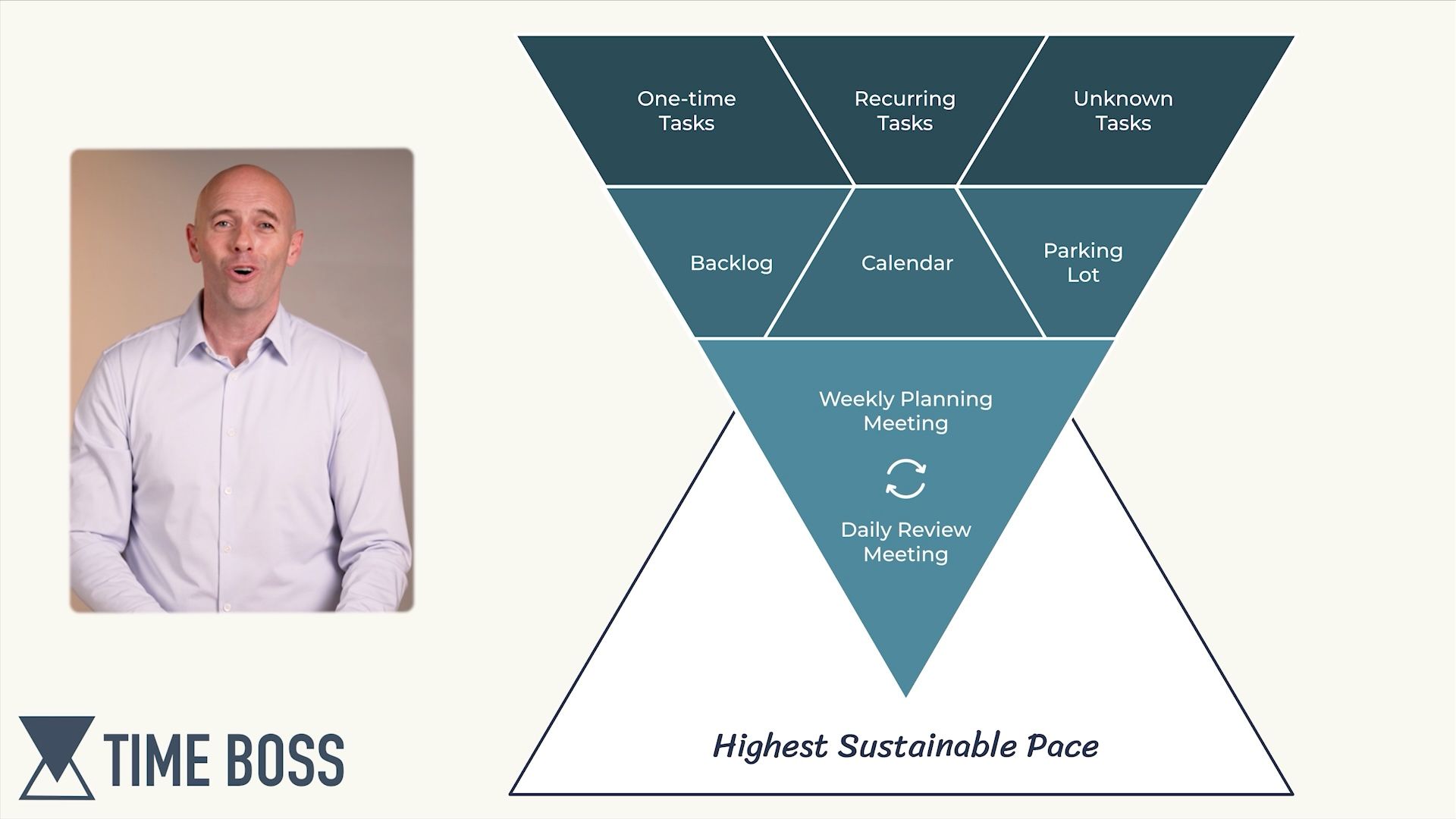
1. Run a Weekly Planning Meeting Every Week & Never Miss It - Before the work week starts, sit down for one hour. No inbox. No messages. Just you, your Calendar, and your Backlog. Decide what matters most this week and prioritize it. Break big tasks into subtasks you can finish in one sitting, two hours max, with a clear definition of done. Then map those items to your calendar like appointments, making time for them the same way you would for any meeting with another human showing up. Reminder that the Time Boss Masterclass has a simple repeatable agenda for this meeting.
2. Budget for Interruptions with Whirlwind - Block 10-40% (no joke) of your workday as buffer for reactive work. In Time Boss we call this Whirlwind (because sometimes that's what it feels like). This is where you intentionally choose to be reactive: email, voicemail, walk-ins, fires. When an interruption hits during focus time, you don't drop everything. You park it in a Parking Lot and handle it during Whirlwind. Check out the Masterclass for even more advanced strategies on Whirlwind.
3. Share Your Plan - Tell someone what you committed to this week. Your boss. Your spouse. A colleague. Sharing doubles your likelihood of follow-through. If you actually value the items you're prioritizing, you should be begging someone to help hold you accountable to this plan.
When you do this, something will begin to shift. You'll start working on your priorities because you've created intention anchors to make them happen. And you'll stop fearing interruptions because you've already made room for them. You'll stop performing, and start producing.
And doing all this from a place of peace, not stress.
The Progress You Want, from a Place of Peace
Time Boss was built to make all of this simple and repeatable. A way to align your calendar to your actual priorities AND budget for the reality of interruptions, AND do it all from a place of PEACE, not stress.
If you want to see the entire framework from start to finish, check out the free Time Boss Masterclass. In 75 minutes or less, you'll see the complete system. Those that implement Time Boss get these results:
- 97% of participants experience more peace and less overwhelm,
- 30%+ productivity jump on average (some as high as 75%!)
- 4 hours a week back in their schedule (some as high as 15 hours!)
If you're the type of leader who knows you need support implementing something like this, or your team is struggling with the same pattern, grab 60 minutes with our team. We'll learn about your unique situation, share some quick wins you can put on your calendar this week, and show you how we might work together to get PEACE and PROGRESS every single week.
My strong encouragement is this: don't send your future self out to wing it one more week. Give them a realistic plan, give them buffer to deal with reality, and watch what happens.
Start small. Start today. Your future self is worth it.
Master Your Time with the Time Boss Newsletter
Practical tips, helpful guides and more delivered bi-weekly.