Why Motivation Isn't Enough for a Fresh Start
Jan 07, 2026Your 2026 "fresh start" is officially underway:
New Year's Resolutions - Check!
Vision Board - Check!
Belief that it will ACTUALLY be different this time - Check!
Bad news: you're very likely to quit on all these items, and even worse, you're likely to quit in the next 7 days.
Good news: you can do something about it. Keep reading.
New Year, Same You
There is something magical in your mind about the turning over of a new year. It's like a super Monday, a chance to start over but "actually" this time, to finally live the life you think you should live.
It also is a clear demarcation of the passing of time, creating this hard-to-scratch itch in your brain that you're getting older, death is that much closer, so you better start actually living the way you want to live.
These two forces combine to give you incredible motivation.
The problem is there is exactly NOTHING different about you on December 31st vs. January 1st.
It's still you, and all your habits you had last year. This newfound motivation will only serve you so far, and on average not past the second Friday in January (It's called "Quitters Day", and it's actually a thing).
So how do you actually do something about this and change?
I've already previewed it: your habits.
Your World Runs on Habits
Whether you acknowledge it or not, your world runs on your habits: learned behaviors you repeat that have helped you survive or thrive up until now.
Your brain loves habits because it loves conserving calories. At a very basic level, it wants to work as little as possible, and habits are learned routines that facilitate this.
Quitters Day exists not because you're weak, but because motivation runs out before your habits change.
The "Fresh Start" You Want is On the Other Side of Time
Regardless of what you added to your New Year's Resolutions or Vision Board for the year, every single one of those things require time:
- Finding time in your schedule to do new things.
- Reworking time in your schedule to stop doing something to start doing something else.
It all requires time.
And just like anything else in your life, your relationship with time is a set of habits:
- When you start work, do you open your email and just start banging away at replies, or do you focus on your highest priority task? This is a habit.
- When someone interrupts you, do you automatically stop what you're doing and help them, or do you evaluate if the request is a higher priority than whatever you were actually working on? This is a habit.
- When you approach your week, do you plan out your time aligned to your goals and values, budgeting time for the inevitable urgent and important interruptions, and dealing with the items that don't fit in your calendar so they don't stress you out all week? Or do you just hope for the best and let it rip without planning? Again, this is a habit.
If you don't like the results you're getting for your time, or you're unhappy with your experience of life, it's time to take a long look at your habits related to time.
The Time Habits That Drive Fresh Starts
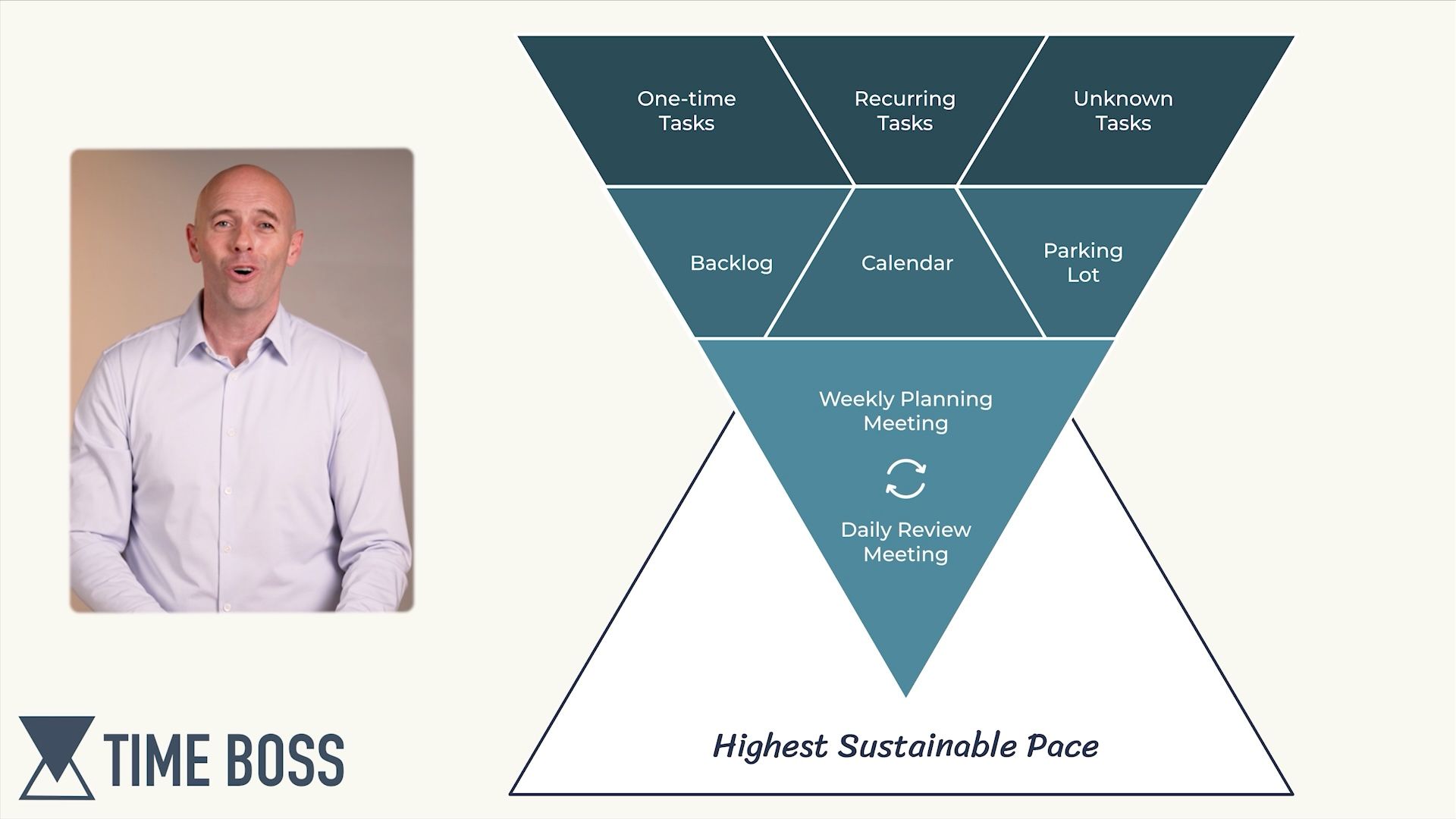
Time Boss is built on two simple and repeatable habits: a Weekly Planning Meeting and Daily Review Meeting.
The Weekly Planning Meeting is a 1-hour meeting that you complete on your own, prior to the beginning of your work week. During this meeting, you assume the role of your Time Boss, with the full focus being to set up your future self to be successful. It involves a few key steps:
- Reflect
- Reflect on your previous week and consider helpful course corrections to help you move towards your Highest Sustainable Pace™.
- Reflect on any work to be done that needs to be captured in your Backlog.
- Decide
- Decide what your actual priorities are aligned to your goals and values, such as the items you added to your New Year's Resolution and Vision Board.
- Decide how you're going to get those priorities done, literally breaking down the work into 1 to 2 hour tasks.
- Decide how much of you're life you're going to give to work this week, add in reasonable buffer (called "Whirlwind") for the unknown urgent and important tasks that you're guaranteed to get interrupted by, then map your priorities to your calendar.
- Decide what to do with the tasks that don't fit, such as deferring or delegating them, so they do not create stress for you all week long.
- Commit
- Commit to your weekly plan by sharing it with someone to increase your commitment
Once this meeting is complete, you take off the Time Boss hat, and now it's time to simply make the plan happen. This is a simple and repeatable habit, week after week, to help you get the results you want, with an experience of life you actually want.
The Daily Review Meeting is your habit to help you stay committed to the plan you create in your Weekly Planning Meeting, and your tool to emotionally separate from your work day so you can be fully present outside of work and actually rest and recover. The Daily Review Meeting is a 15 minute meeting at the end of your day, with three key steps:
- Reflect - Reflect on what worked, what didn't work, and what course correct is needed for tomorrow. Without this step you will often ruminate all evening, particularly on what didn't work. Reflecting and determining a course correction helps your brain feel like it's already working on the solve, freeing your brain to not worry about it throughout the evening or weekend.
- Decide - Decide what to do with any undone items, such as rescheduling them, or adding them to your Backlog. The goal is to keep these items in the system and not in your head, so you don't worry about them away from work.
- Commit - Commit to the plan you have scheduled in tomorrow's calendar. The simple act of reviewing tomorrow's calendar reassures your brain that you have a good plan that's realistic, allowing your brain to emotionally detach from it, and be fully present to your life outside of work.
Again, a simple and repeatable habit, allowing you to emotionally detach from work, be fully present and actually rest and recover.
Sounds Awesome, But Where Do You Start?
If you're ready to change your habits related to time, you can learn the Weekly Planning Meeting and the Daily Review Meeting in 90 minutes for free via the Time Boss Masterclass and start putting it into place today.
If you know you're the kind of person that needs accountability to make life change happen, I'd invite you to check out the "Master Your Week" course launching quarterly. You'll join 4 to 6 other leaders just like you looking to get the results they want, and do so without overwhelm.
If you're a company leader looking at a training calendar for your team, consider a Time Boss Workshop or Group Coaching to give your team a simple, repeatable approach to time that increases their peace AND their productivity.
The fresh start you're after is absolutely possible, you simply need to focus on your habits related to time. Rooting for your success this year!
Master Your Time with the Time Boss Newsletter
Practical tips, helpful guides and more delivered bi-weekly.