You Confuse Worry with Work
It happened again today.
You copied over that item to your to-do list that you still haven't done.
You felt your stomach turn.
It should have been done 3 weeks ago.
- What if they find out and are frustrated it's not done?
- What if not doing it yet comes back to bite you?
You considered doing it today, but…
- You didn't have enough time…, or
- You weren't sure what to do next…, or
- You weren't sure it was even still important to anyone.
So you just let it sit on your list all day.
Every time you glanced at it you felt guilty.
The day ended, and the task still wasn't done.
At least there's always tomorrow, right?
You Confuse Worry with Work
The average knowledge worker, regardless of their seniority, repeats the ritual above every single day, because they have confused worry with work.
You care deeply about the tasks on your to-do list. They are connected to results you want (e.g. goals, KPIs, promotions, etc.) or relationships you care about (e.g. teammates, employees, investors, bosses, partners, etc.). You're afraid if you don't take action on them, it will hurt you or hurt someone you care about.
For many tasks on your to-do list, you take action on them and make them happen. But every knowledge worker has more to do than time to do it, and this means you have items on your to-do list that you're NEVER going to get to. In workshops, I refer to these as “the children you're not feeding.”
Let me cut to the punchline: you need to do something with these tasks. And you actually intuitively believe this. You simply think that writing, and rewriting, AND rewriting that item on your list day after day after day, and feeling worry, guilt and concern each time you look at it, is the same as work.
Worry is not work.
Operating this way is impacting the results you're getting for your time, and your experience of life.
Your problem is it feels like work. Here's why.
Worry Depletes Your Finite Mental Energy
If you had a decent night's sleep, you woke up this morning with the equivalent of a cell phone battery in your head. Fully charged, ready for the day.
Everything you do, every decision you make, every thought you think, draws down energy from that cell phone battery. And in fact, the more emotional the thought, the more it depletes your finite energy.
Every time you look at the tasks you're not doing, it costs you energy. The longer you've gone without completing a task, and the more you've blown up the story of the delay (e.g. “What if they find out?”), the more energy this costs your brain.
As the day drags on, and you deplete this energy, you begin to make poorer decisions. This is why you're more likely to doomscroll, eat that bag of Skittles, and order one too many drinks at the end of the day. It can feel like you have no willpower left to fight it.
Your energy is zero-sum. Any energy given to worry is energy you're not giving to your actual priorities, the things that you actually have time to do today and are aligned to your goals and values.
Even worse, worry robs you of your peace, and makes you believe there isn't enough time. Not only does this impact the experience of life you actually want, but it constricts your thinking, making you feel the need to work faster, which makes it harder to seek best practice, collaborate and delegate.
Worry-driven Deferring is a Half Solution
Your brain is confusing worry with work, and only solving half the problem.
It knows you don't have enough time today, so it looks at tomorrow and says “maybe?” Technically it's deferring the work, which is a valid strategy. It's just not doing it right.
Here's how this looks:
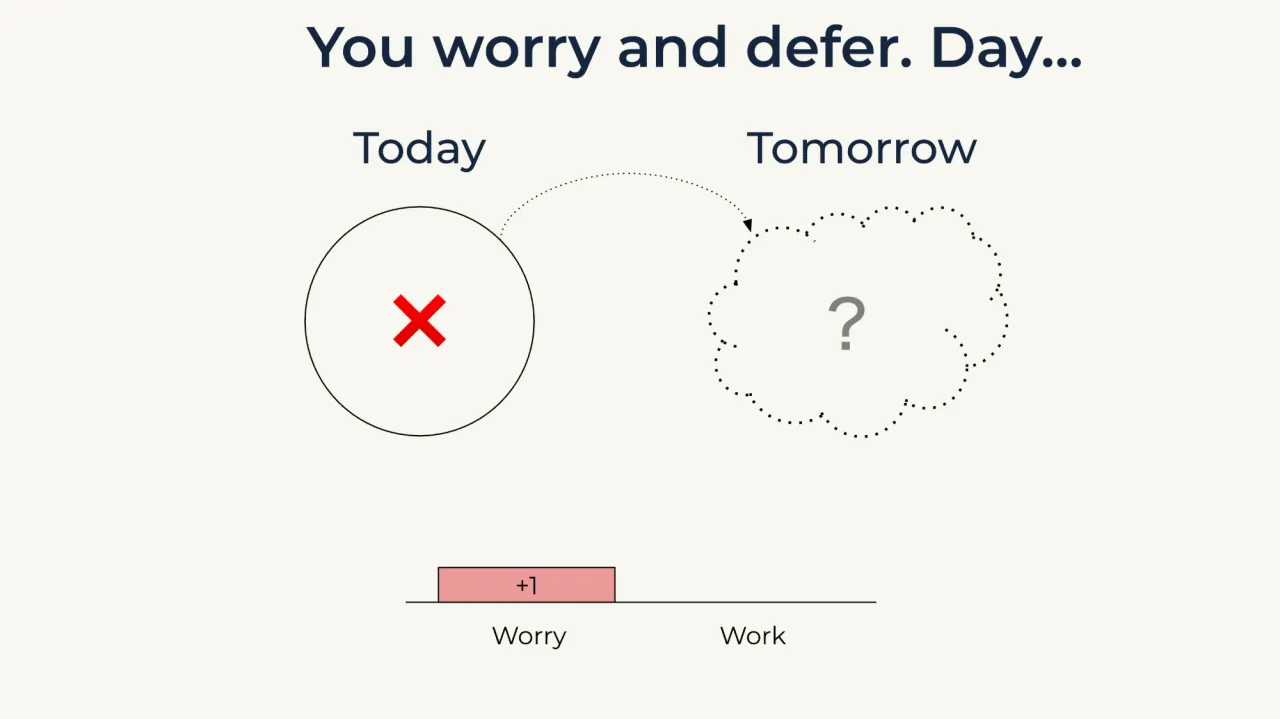
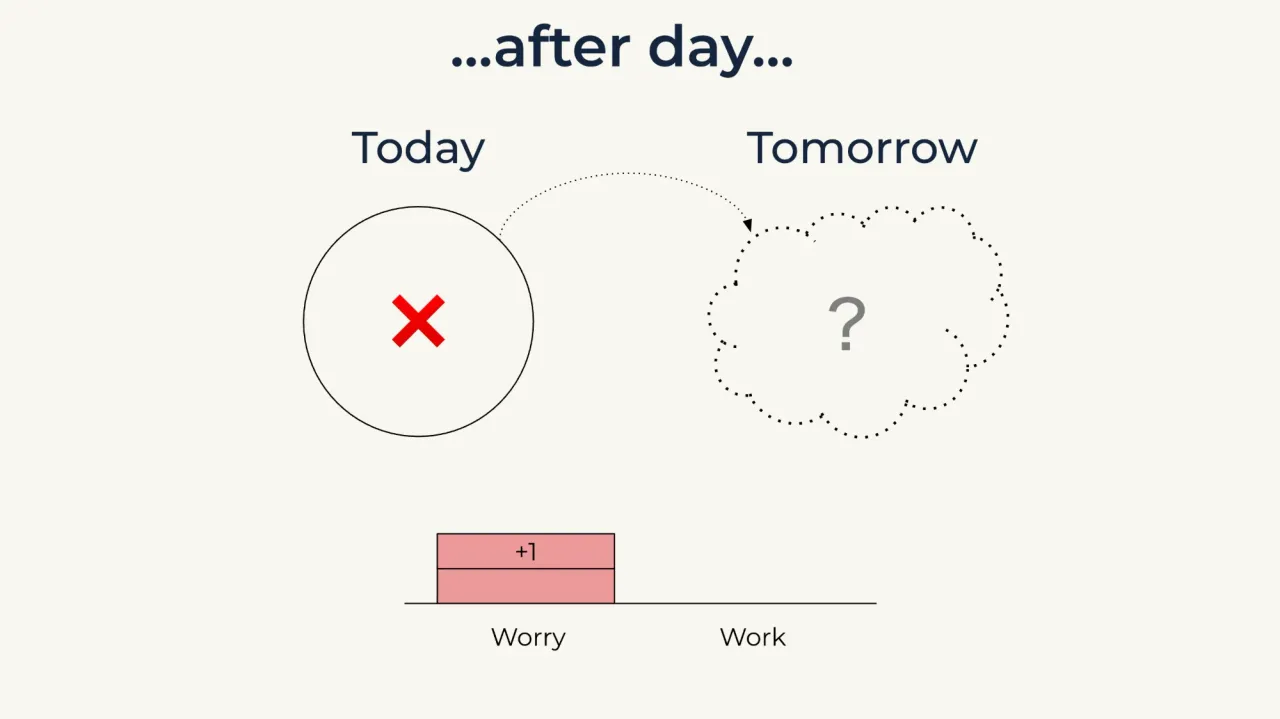
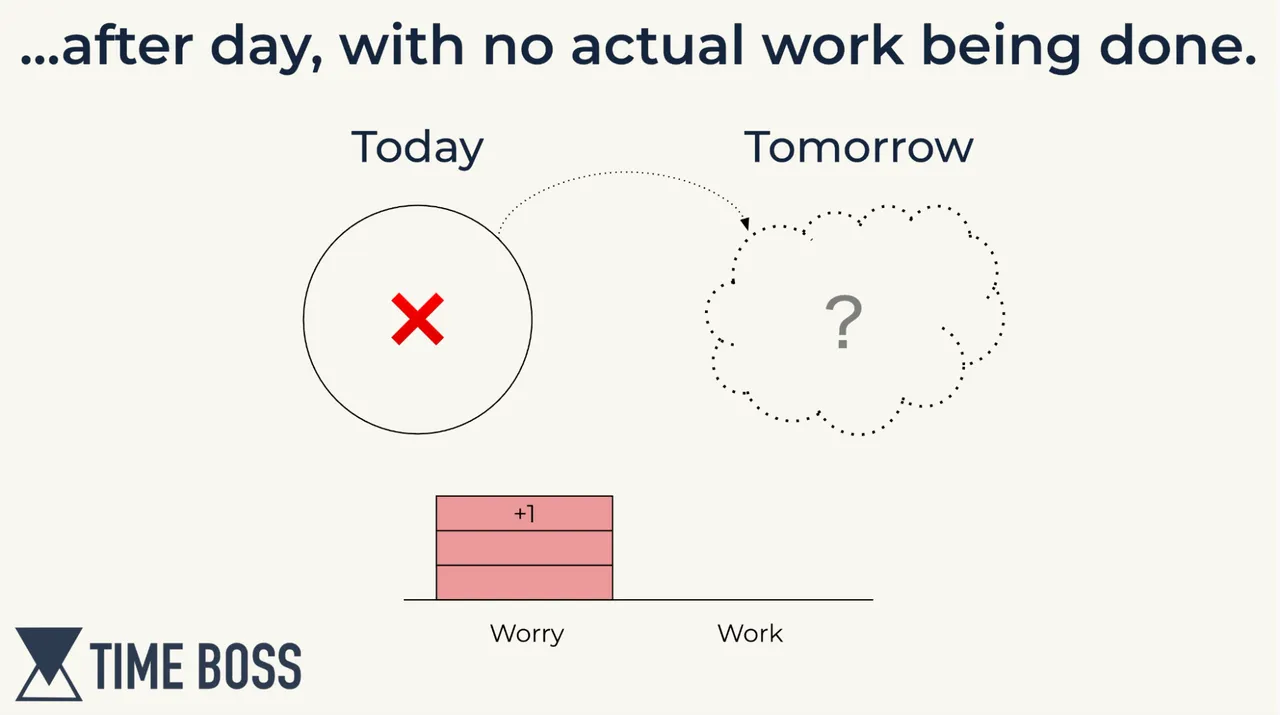
Days pass, no work is done, and worry compounds day after day.
Deferring is a valid strategy when done correctly, and it's one of four powerful options you can use to actually do something besides worry.
We call these options “Commitment Plans.”
Fight Worry with Commitment Plans
In Deep Work, Cal Newport quotes a study called “Consider it Done” that found that you don't actually have to complete a task to stop worrying about it. You simply need a Commitment Plan:
“Committing to a specific plan for a goal... may free cognitive resources for other pursuits”
Think of it like hiring a babysitter for your kids so you can go on a date with your spouse. You don't have to be physically there watching your children to feel relief they are safe, because you've created a Commitment Plan for them: the babysitter. Hiring a babysitter doesn't absolve you of being a parent. It simply allows you to temporarily separate from your children to fully focus on your spouse.
Commitment Plans are like babysitters for your tasks, freeing up your brain to be fully present to the thing in front of you. This is the unlock: you don't have to complete every task to stop worrying about it. You simply need a Commitment Plan.
You have a powerful choice to make: is this thing you're worrying about actually a priority or not? Let's start by assuming it is.
If the thing you're worrying about is actually a priority
If this is the case, you have three options:
- Date It: Stop worrying about the task and block time on your calendar to do it. If you're not sure of the next step, ask an AI. They are incredible at making work manageable. Treat it like the President of the United States is showing up to the meeting (you can pick which President, past or current). If you do so, you will stop worrying about the task, and actually take action on it.
- Delegate It: Can someone else handle the task 70% as well as you? Delegate it and stop worrying about it. If you've struggled delegating in the past, we have a great article for you.
- Defer It (the right way): If the task is a priority, but it can wait until next week / month / quarter / year, defer it. To do this the right way, you need a system you trust to hold these tasks you defer so you can stop worrying about them until your predetermined date. No more simply tossing it over the fence to future you tomorrow. Choose a date with intention, and stop worrying about that task.
If the thing you're worrying about isn't actually a priority
- Delete It: This is not always an option, but can you simply decide to do less and say “no” to non-priority tasks? If you've been writing a task over and over and over on your to-do list, not doing it and simply feeling worried about it, just delete it and cut it loose. You are revealing to yourself that it's not actually your priority.
It's important to recognize that this is not easy. When meeting with our Time Boss clients in group coaching, we spend almost all of our time here, and I help them creatively think through the right Commitment Plans. It's important to have outside feedback on your calendar, and ensure you are being honest with yourself about how finite your time is.
Stop the Worry Now
Do this now:
- Find the oldest task on your list that you keep writing and rewriting day after day.
- Use a Commitment Plan from the list above.
- Stop worrying about it, and get on to the real work.
It's literally that simple.
Time Boss is a Simple, Repeatable Way to Create Commitment Plans
Dating tasks on a calendar that's out of control doesn't solve the problem, and neither does deferring tasks without putting them in a system that you trust. So how do you do this in a way that will actually stick?
Enter Time Boss.
Time Boss is a simple, repeatable way to create Commitment Plans your brain will trust, allowing you to get incredible results with a system you actually want.
Leaders that implement Time Boss report the following:
- 43% increase in productivity
- 4.8 hours back in their week
- 95% of leaders report more peace, less overwhelm
Time Boss is a simple set of tools and habits we teach and ingrain via Workshops, Group Coaching, and ongoing support. If you're an individual leader, it's going to transform your world. Learn the Time Boss Framework at an Unlock Your Week Workshop, or ingrain the Time Boss tools and habits in your life via the Master Your Week 6-week group coaching.
If you're a CEO, founder or team leader, Time Boss impact is exponential. Check out some of our success stories, and if you want to get a sense of where your team is at, take the free Leadership Team Time Audit now. You'll get an instant readout, with a recommended next step to take with your team this week.
It's time to stop confusing worry with work, and Time Boss is your framework to take the next step.